
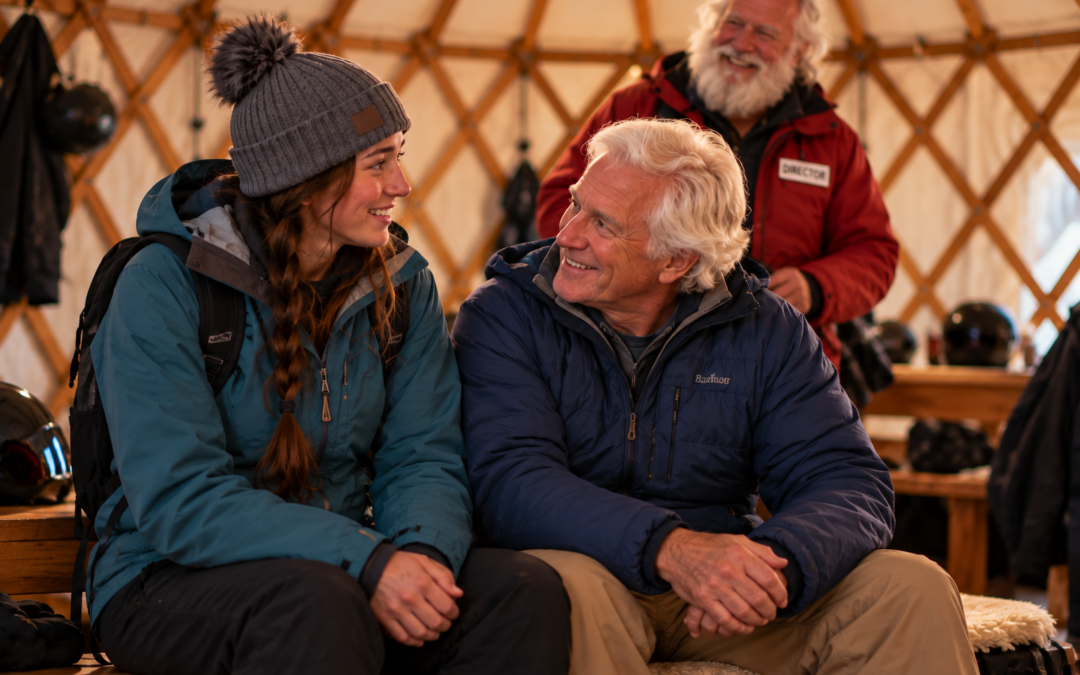
TL;DR: You do it before anybody has to ask, and then you say nothing about it. My first day of adaptive snowboarding, I walked into a packed yurt in Pennsylvania and could not find anywhere to sit. A man with white hair scooted over and made room. That is the whole thing.
The yurt was small and full of people talking and laughing, and I was standing in the middle of it with nowhere to sit. I had flown to Pennsylvania by myself for my first snowboard trip, terrified, hiding it. Bill, the director, had just checked me in. He looked like the ski version of Santa Claus, white hair connected to a white beard, blue eyes, a kind soul. He told me to grab a seat and he would come help me with my braces shortly.
There was no seat. I stood there feeling every bit of it.
Then a man with white hair and a warm, inviting smile scooted over and offered me the space beside him. He did not announce anything. He sat down next to me, introduced himself, and started a conversation, and the fear began to drain out of my hands while we talked.
I think about that man more than he could possibly imagine. As a corporate keynote speaker I get asked constantly how to build a culture where people feel included — and everybody wants the framework. He did it in about four seconds, without once using the word inclusion.
Notice the difference between what he did and what usually happens. Nobody stood up and cleared a path. Nobody asked loudly whether I needed anything. He moved eight inches and left me my dignity, which is the part most people skip. Then Bill came over, pulled up a chair, and tightened my braces for me like it was nothing at all, because to him it was.
Sometimes we must do the things we fear most in order to have fun.
— I’m Not Limping. That’s Swagger!, Chapter 7
I did not catch his name either. A few weeks later somebody introduced Kelsey Tainsh to a ballroom, and I told them about him.
How to be the person who scoots over
- Move first. Do not ask a room whether somebody needs help.
- Make the help smaller than the moment, never bigger.
- Then start a normal conversation, so it stays a normal day.
If any of this sounds like your organization right now, I would love to talk about it, on your stage or over email. Most of what I do as a corporate keynote speaker comes back to four seconds like these. And if you would rather just read the rest of the story, the book is out.
Book: https://kelseytainsh.com/kelseys-book/ · Speaking: https://kelseytainsh.com/corporate-keynotes/
Questions people ask me about this one
Should I offer help to a coworker with a disability, or wait to be asked?
Offer, quietly, and accept a no the first time without a discussion. The man in the yurt did not ask me whether I needed a seat. He made one and went back to his conversation. That gave me room to take it or leave it. Public offers put the other person on stage, and most of us are already tired of being looked at.
Is it patronizing to help somebody who has not requested it?
It becomes patronizing when it is performed. The tell is volume. If you announce it, ask twice, or want to be thanked afterward, the help has quietly become about you. If you move over, hand something across, or fix a thing without commentary, almost nobody in the world minds that.
What if I do it wrong and offend someone?
You will sometimes, and it is survivable. I have had people grab my right arm to steady me, which is the arm that does not work, and I just say so. A person acting from kindness is easy to correct. A person who never tries is the harder problem, and there are far more of them.
Quote Q28 pulled from Chapter 7. Confirm against print edition before publishing.
Recent Comments