
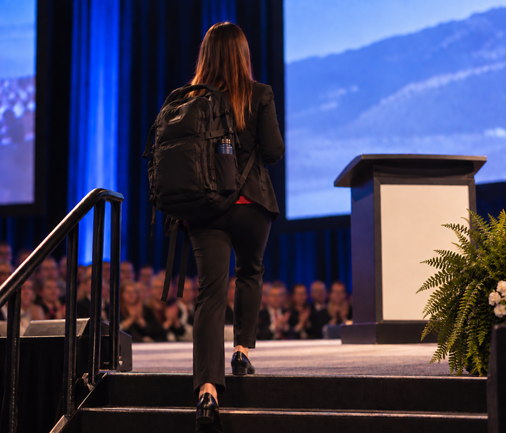
TL;DR: More than you would guess, and most of it never comes up in a meeting. On March 22, 2018, Richard Menneg asked me to bring my heavy backpack on stage at the ATI Super Conference. I thought he meant the bag. He was showing five hundred people what I had carried before I said a word.
Richard Menneg hired a twenty-seven-year-old named Kelsey Tainsh to keynote his conference, which made me the youngest speaker they had ever put on that stage. He met with me in Atlanta a few months out to talk through his ideas, and he had one strange request. He wanted me to bring my heavy backpack up on stage with me, because I always carried it everywhere.
I said yes. I had no idea what he was doing.
To me that backpack was a laptop, paper, pens, headphones and chargers. It was something heavy I hauled through airports. I stood backstage in Orlando gripping the left strap of it, feeling the cold floor through thin dress shoes, waiting to hear my name.
I walked out, set it down by the podium, and started talking. When I finished I picked it up by one strap and walked off to a standing ovation. I did not understand for years what the audience had actually watched. Before I said a single word, Richard had shown five hundred people the weight I had already carried — and then let them watch me set it down.
That is the best piece of leadership I have ever been on the receiving end of, and in ten years as a corporate keynote speaker I have not seen it done better. He did it without one conversation about my feelings. Every person on your team walked in this morning with a backpack. Most of them will never mention it, and a few of them are hauling something you would not believe. You do not have to make anybody open it up in front of a room. You only have to remember that it is on their shoulders while you are asking them for something.
That day taught me something I’ve never forgotten—that what we carry can either weigh us down or lift us up, depending on what we do with it.
— I’m Not Limping. That’s Swagger!, Chapter 5
I walked off that stage lighter than I had been in years. It was the same bag.
What this changes about how you lead
- Assume a full backpack. Ask for the work, not the explanation.
- Give people a place to set it down before the hard thing.
- Notice the weight out loud once. Do not make it a program.
Chapter 5 of my book is about the people who took a chance on me before I had earned it, and Richard is the first one in it. If your leaders are trying to figure out what their teams are carrying this year, that is the conversation I would rather have than any other as a corporate keynote speaker.
Book: https://kelseytainsh.com/kelseys-book/ · Speaking: https://kelseytainsh.com/corporate-keynotes/
Things leaders ask me after this talk
How do you ask what someone is carrying without prying?
Ask about capacity instead of circumstances. What is on your plate this month, and what should come off it, gets you nearly everything you need to know without anybody having to hand over a private story. People will tell you more once they learn you can hear it without turning it into a whole meeting about them.
Isn’t this just an excuse for people to underperform?
I have not found that to be true, and I say that as somebody who is fairly hardheaded about effort. Knowing what a person is hauling does not mean lowering the bar. It means you stop misreading tired as uninterested. The people I have seen coast were not the ones carrying something heavy. They were usually the ones nobody had asked.
What made Richard’s version work when most empathy exercises flop?
He never announced it. There was no slide about the invisible weight we all carry and no moment where the audience was told what to feel. He put a real object on a real stage and let five hundred people work it out themselves. Anything you have to explain to a room has already stopped doing the thing you wanted it to do.
Quote Q19 pulled from Chapter 5. Confirm against print edition before publishing.
Recent Comments